

Accelerating Our Green Transformation
Our key operations, including the headquarters office, property services, and hospitality operations, are ISO 14001:2015 certified, demonstrating the effectiveness of our environmental management systems. Our commitment to environmental sustainability is guided by our Climate Change Policy and Sustainability Policy, which outline ongoing commitments and improvements in reducing carbon emissions, enhancing energy efficiency, and expanding the use of renewable energy sources across our operations.

Case Study

Decarbonisation Efforts at Nina Hub
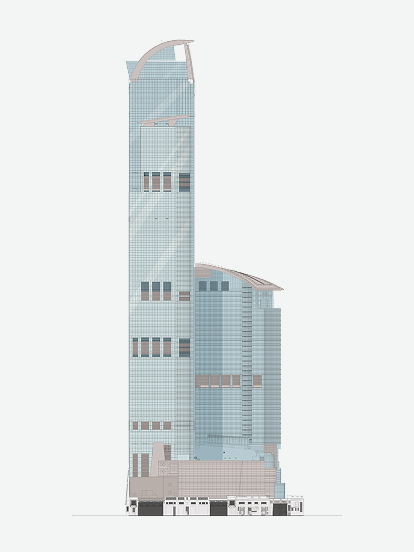
Nina Tower, home to NINA MALL and Nina Hotel Tsuen Wan West, is a mixed-use development located in the heart of the Tsuen Wan district. With a commitment to decarbonisation efforts and enhancing operational efficiency, Nina Tower is undergoing a major upgrade in sustainable infrastructure, including the phased installation of a zero-carbon chiller system, implemented in partnership with CLP Power Hong Kong Limited. At NINA MALL, where foot traffic is particularly high, cutting-edge technology is being integrated to optimise energy consumption. A 5G predictive control system for air conditioning complements the energy-efficient chiller system, enhancing overall performance.
Nina Tower’s decarbonisation strategy centres around four key components: hardware replacement, an AI predictive model, a digital twin pilot and clean energy offset. These initiatives are designed to maximise performance by leveraging AI and machine learning to recommend optimal operational parameters.


Hardware Replacement

AI Predictive Model

Digital Twin Pilot

Clean Energy Offset
Hardware Replacement
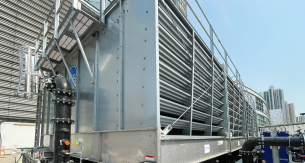
Transition from air-cooled to water-cooled chiller systems can significantly reduce energy consumption. Another environmentally conscious upgrade involves using the eco-friendly refrigerant, which has a significantly lower impact on the environment compared to the standard refrigerant.
- Achieve up to 50% energy savings in MVAC system, supplemented by advanced control technologies
- Expected to save more than 8,500,000 kWh under full operation compared to 2024 level
AI Predictive Model
The AI predictive model, which uses a cooling load predictive model developed by CLP Power Hong Kong Limited, is employed in NINA MALL where foot traffic is particularly high. It is equipped with digital control systems for both waterside and airside systems, taking into account environmental and occupancy factors.
The operation cost can be minimised since data used by the predictive model comes from the 5G webcam system for people counting.
The investment has successfully recovered its cost within one year, demonstrating outstanding performance. Looking forward, CCG is studying the feasibility of extending the application of similar prediction models to other projects.
- Achieved estimated energy saving of 675,000 kWh annually since implementation
- 20% improvement in labour efficiency in facility management
- Improved comfort level at NINA MALL
Digital Twin Pilot
The digital twin pilot is being applied in the zero-carbon chiller system at Nina Tower.
The AI model uses data retrieved from the BMS to develop self-trained physics-guided machine learning models for optimising the system. This AI-driven model blends physical principles with machine learning, ensuring an accurate modelling of actual performance.
- Monitor the plant's efficiency and healthiness
- Extend the end-of-life of chillers through a comprehensive maintenance plan
Clean Energy Offset
The electricity consumed by the chiller plants at Nina Tower will be matched by an equivalent amount of Green Electricity Certificates linked to renewable energy projects in Mainland China.
Carbon Footprint Management
Performance Highlights
Compared to the previous year, carbon intensity in FY2024/25:
-11.8%in Property Services
-19.6%in Hospitality

Total Carbon Emissions (Scope 1 and 2)*
(*Location-based method)
Since FY2024/25, carbon emissions from D·PARK and Pine Care operations has been included in the reporting scope, contributing to an increase in total carbon emissions (Scope 1 and 2).
Moreover, CCG continues to optimise the methodology to adopt industry common intensity metrics for calculation and better benchmarking. Therefore, starting from FY2024/25, CCG no longer solely uses the floor area to report intensity values.
Carbon Emissions Intensity (Scope 1 and 2)*
(*Location-based method)
tCO₂e per floor area
Carbon Emissions Intensity (Scope 1 and 2)*
(*Location-based method)
tCO₂e per occupied room night or occupied place night, applicable to business segments of Hospitality and Healthcare
We support a low-carbon economy transition with our ambitious Carbon Reduction Roadmap – CCG 3050+ (“CCG 3050+”), which aligns with targets to limit global warming to 1.5˚C above pre-industrial levels, as approved by the Science Based Targets initiative (“SBTi”) in 2022. CCG conducts annual carbon footprint assessments, reviews performance, and develops enhanced carbon reduction strategies.
CGG 3050+ Targets
51.8%
Reduction in operational carbon intensity (Scope 1 and 2) in 2030 compared to the 2020 base year.
2024 Progress
27.7%
Reduction

To address our Scope 3 carbon emissions, we conducted a carbon inventory screening and identified Category 2: Capital Goods as a material hotspot. This category accounts for the upfront embodied carbon from our construction projects, as referenced in the SBTi Buildings Sector Explanatory Document. We assess embodied carbon using the cradle- to-site (A1 – A5 stages) approach, supported by the CIC Carbon Assessment Tool, which complies with ISO 14040:2006 standards for life cycle assessment. In collaboration with contractors as specified in contractual agreements, we collect data from purchase records of concrete, steel, façade materials, and other relevant materials to input into the tool. This practice enables the accurate measurement of embodied carbon in key building components and consolidates monitoring data from the construction site. Since FY2023/24, CCG has formally reported Scope 3 emissions under Category 2: Capital Goods for newly completed developments during the Reporting Period.
Energy Efficiency
Total Energy Consumption
Since FY2024/25, energy consumption from D·PARK and Pine Care operations has been included in the reporting scope, resulting in an increase in total energy consumption. Additionally, as the number of employees at the Headquarters Office grew by 5.3% during the Reporting Period, its energy intensity slightly increased in FY2024/25.
Energy Intensity
kWh per floor area
Energy Intensity
kWh per occupied room night or occupied place night, applicable to business segments of Hospitality and Healthcare
Apart from the energy efficiency features in new development projects showcased in the section “Demonstrating Green Building Leadership”, CCG has implemented a range of energy efficiency measures in existing buildings. These measures focus on replacing chiller plants and heat pumps, upgrading escalators, installing LED lightings and occupancy sensors, as well as conducting retro-commissioning to optimise the performance of building systems. For instance, Nina Tower has pioneered Hong Kong’s first zero-carbon chiller replacement project. For details, please refer to the Case Study of “Decarbonisation Efforts at Nina Hub”. Nina Hotel Kowloon East also installed three units of water-cooled chiller in FY2022/23, connected to cooling towers, and chilled and condenser water pumps with higher efficiency. These savings have all been successfully reflected in the reduction in carbon and energy intensity in FY2024/25.
Renewable Energy
Renewable energy enables the transition to low-carbon operations, by reducing Scope 2 carbon emissions.
71,320kWh
Of renewable energy generated during the Reporting Period
149%
Increase compared to the previous year

104,875kWh
Of renewable energy purchased via renewable energy certificates issued by reputable local providers
5%
Increase compared to the previous year

CCG is committed to integrating on-site renewable energy into new development projects wherever feasible. In FY2024/25, over 30% of our active new development projects are designed to incorporate renewable energy systems, with an expected annual generation of over 500,000 kWh. This contributes to long-term energy resilience and cost savings.
We continue to seek opportunities to expand renewable energy generation across our existing portfolio by conducting feasibility studies and securing off-site renewable energy options wherever feasible.
Nina Park is a good showcase of introducing experimental renewable energy technologies beyond traditional energy systems.

Solar Panel System
- Installed with 186 solar panels
- Generated 71,320 kWh of electricity in FY2024/25, covering approximately 27% of Nina Park’s overall annual power consumption

Smart Bench System
- Equipped with CCTVs, reading lights, and a water-cooling feature using recycled rainwater with fans and motion sensors, all powered by 36 experimental steppable solar panels

Outdoor Recharge Bike
- Integrates exercise and energy conservation, where visitors can charge their electronic devices by pedalling
- Eight resistance levels for different workout intensities
- Displays information on distance, speed and time
Waste Management

CCG is dedicated to minimising waste and enhancing recycling across our businesses and value chain to contribute to a circular economy. Our commitment to waste reduction extends beyond project design and construction. We implement strategies to prevent waste in our operations and leverage digital tools and technologies to manage resource consumption effectively.
Performance Highlights
Composition of Materials Recycled (Non-hazardous waste) in FY2024/25

Since FY2024/25, materials recycled from D·PARK and Pine Care operations have been included in the reporting scope, resulting in an increase in total materials recycled, with the majority of this increase attributed to food waste from Pine Care operations.
Food Waste
Acknowledging food waste as a significant component of Hong Kong’s municipal waste stream, we have implemented various measures to manage and reduce our food waste.
604.5tonnes
Of food waste diverted from landfill during the Reporting Period
262.2%
Increase compared to the previous year

To better manage food waste at our malls, we actively promote EPD food waste collection programme among our food and beverage (“F&B”) tenants. The participating malls are equipped with collection bins provided by EPD for daily collection by their contractors, which are then transported to the Government’s treatment facilities for further waste- to-energy treatment and composting purposes. Currently, three of our eligible malls are participating in this initiative. In the future, we aim to collaborate with EPD to conduct site visits and assess the operational readiness of all eligible malls with F&B tenants.
Nina Hospitality has a comprehensive food waste circularity management strategy that encompasses food procurement, production, consumption, and waste management.
Nina Hospitality’s Circular Economy Strategy on Food Waste
Food Procurement
- Develop farm-to-table concepts in restaurants to support local businesses and promote a low-carbon dining culture, such as cooperation with Farmacy and ValleyFarm
- Avoid over-ordering of ingredients and food supplies through monthly inventory checks
- Select products with less processing and packaging
- Adopt of eco-friendly plastic-free takeaway containers and cutlery
Food Production
- Fully utilise all parts of food ingredients when planning a new menu
Food Consumption
- Serve food in appropriate portions, such as offering smaller portions for buffet food
- Allow guests to select their portion size when ordering
- Encourage guests to take away their leftovers by carrying out a Bring Your Own Container (“BYOC”) scheme


Food Waste Management
- Implement a daily leftovers and waste log for better menu planning
- Maximise the use of imperfect food or upcycle food waste into new dishes using natural additives or ingredients
- Enhance waste separation at the source through training and ongoing monitoring
- Encourage guests to bring their own reusable containers to take home any excess coffee grounds at our buffet restaurants for personal use

- Provide surplus food to those in need in the community through the charity Foodlink Foundation
- Reduce food waste sent to landfill by using on-site composting machines and transporting excess food waste to the Government’s treatment facilities for further waste-to- energy treatment and composting purposes
- A remarkable 90.4% food waste recovery rate was achieved during the Reporting Period, significantly surpassing our 65% target
In an ongoing effort to increase awareness and knowledge among staff about food waste treatment, Nina Hospitality conducts regular training sessions on the importance of reducing food waste and best practices for waste management, particularly in source separation. Additional guidance has been provided to relevant staff, helping them to comply with food waste management requirements safely and effectively especially on handling on-site composting machines. Through actively connecting with our hotel guests to participate in waste reduction initiatives and training up our staff, food waste recycled by Nina Hospitality has been increased by 45.6% during the Reporting Period compared to FY2023/24.
Plastic Waste
Nina Hospitality is dedicated to reducing plastic waste and safeguarding the environment. Aligned to the Product Eco-responsibility Ordinance of Hong Kong SAR Government, we offer eco-friendly amenities to our guests. Since April 2024, we have also replaced bottled water with canned water and refillable carboy water, with two of our hotels including Nina Hotel Kowloon East and Lodgewood by Nina Hospitality Mongkok leading the way by installing water dispensers to further minimise single-use plastics. In ad dition, all our hotels provide umbrella drying machines since 2023, eliminating the need for plastic umbrella covers.


>168,000
single-use plastic bottles avoided during the Reporting Period due to the installation of water dispensers

Our efforts extend to our F&B operations, where we have transitioned to eco-friendly materials for takeaway utensils. We have also introduced double-layer takeaway cups, which remove the need for paper sleeves, and redesigned the packaging of our signature palmier by replacing plastic bags with foil alternatives. To encourage sustainable habits among our guests, we have implemented the BYOC Campaign, which aligns with EPD’s “Plastic-Free Takeaway, Use Reusable Tableware” campaigns. By offering discounts to customers who bring their own containers, we promote eco-conscious behaviour and foster active participation in plastic waste reduction.
Construction Waste & Sustainable Construction Material
While all our development projects have a comprehensive waste management plan, we further reduce construction waste by adopting advanced construction practices, such as BIM, MiC and MiMEP, with off-site prefabrication. We prioritise the use of construction materials with high recycled content, such as pulverised fuel ash (“PFA”) concrete and ground granulated blast-furnace slag (“GGBS”) concrete. In addition, to achieve a high standard of construction waste management, we request that our foundation contractors reuse surplus construction and demolition (“C&D”) materials at other construction sites. There is also a target on waste recycling for all development projects to increase the recovery rate.
Case Study
Greeners Action Zero Packaging Fiesta
CCG proudly supported the Zero Packaging Fiesta 2024, organised by environmental charity Greeners Action. This event featured sustainable markets, eco-friendly workshops, educational forums, and exhibitions designed to raise awareness about the importance of waste reduction and recycling. Over two days, we welcomed more than 12,000 visitors and avoided using 1,100 pieces of single- use packaging.
Among the highlights were upcycling workshops that engaged both adults and children in a fun and practical manner. Popular sessions included the Denim Mobile Phone Strap DIY Workshop, Natural Mosquito Repellent Workshop, and the Mooncake Box Marble Maze Parent-Child DIY Workshop, all of which drew enthusiastic participation.
Complementing these hands-on activities were four information-sharing sessions that covered sustainability topics, including the circular economy, reducing single- use plastics, and climate change mitigation strategies. Our representative from Nina Hospitality shared practical actions taken to reduce waste generation in hotel operations. This event fostered community engagement and encouraged a collective commitment to sustainable practices.


Case Study
EMAHK Waste Challenge
CCG participated as a case sponsor and a member of the judging panel of the 2024 Waste Challenge: Innovate to Eliminate, organised by the Environmental Management Association of Hong Kong Limited (“EMAHK”). The challenge aimed to raise awareness of Hong Kong’s waste management issues by incorporating real-world waste management challenges into the competition. As a case sponsor, we engaged with participating teams by organising site visits and briefing sessions to provide insights on the waste management challenges faced within our businesses. Our focus was on the topic, “Towards Zero Waste: Implementing a Circular Economy for Nina Park and the Commercial Neighbourhood”. Participating teams helped develop practical solutions to the issues identified by case sponsors and presented these ideas to the judging panel. On presentation day, three teams presented their innovative solutions to our topic, incorporating smart technologies and creative implementation strategies. This challenge not only increased awareness of real-life waste management issues but also fostered collaboration and innovation.


CCG organised a red packet (“lai see”) recycling initiative with active participation from colleagues at 36 properties, successfully recycling approximately 120 kg of red packets. During Mid-Autumn Festival, CCG also organised a mooncake box recycling programme, and collected a total of 240 mooncake boxes from residents, tenants, and visitors of 21 properties.
In addition to supporting the EPD’s Reverse Vending Machine (“RVM”) Pilot Scheme, we have gone the extra mile by installing 18 RVMs with CCG Hearts point incentive across our properties to further encourage the public to recycle plastic beverage containers. A total of 188,924 bottles have been collected as of the end of the Reporting Period since the RVM’s first installation in October 2023.
In July and August 2024, CCG organised the Summer Olympics Plastic Bottle Recycling Initiative across NINA MALL, D·PARK, and Central Market. The campaign featured live Olympic screenings, where CCG Hearts members could redeem an electrolyte drink to cheer on their favourite Olympians. To encourage recycling habits, members who returned their empty bottles were rewarded with 500 CCG Hearts Points. The initiative successfully engaged the community, resulting in the collection of over 1,280 plastic bottles for recycling.


From January to March 2025, CCG collaborated with local artist Busymama Benny and various stakeholders to present Panda Art Land at D·PARK. The event featured a panda art installation and a bamboo forest arch made from 100% upcycled materials, supporting CCG’s waste reduction goals. There were also art workshops for students focused on environmental conservation and the protection of pandas.


Water Efficiency
At CCG, we strive to conserve water resources. To foster a culture of water conservation among our stakeholders, we also actively educate our colleagues, tenants, residents, and hotel guests on water preservation initiatives.
Performance Highlights
Total Amount of Water Consumption
1 This figure has been restated following enhancements to the data collection mechanism.
Water Intensity
㎥ per floor area
Water Intensity
㎥ per occupied room night or occupied place night, applicable to business segments of Hospitality and Healthcare
Since FY2024/25, water consumption from D·PARK and Pine Care operations has been included in the reporting scope, resulting in an increase in total water consumption. Additionally, as the number of employees at the Headquarters Office grew by 5.3% during the Reporting Period, its water intensity slightly increased in FY2024/25. As for Hospitality, following the gradual transition from an air-cooled to a water-cooled chiller plant system at Nina Hub recently, water consumption at Nina Hotel Tsuen Wan West has increased compared to FY2023/24. The Group is enhancing its data collection mechanism and plans to exclude makeup water consumption of Nina Hotel Tsuen Wan West starting from FY2025/26, ensuring that reported usage reflects what is within our control and can be influenced by water-saving initiatives.
To support this commitment, CCG participates in the Quality Water Supply Scheme for Buildings initiated by the Hong Kong Water Supplies Department (“WSD”). Over 97% of our eligible existing buildings are certified under this scheme, demonstrating our commitment to maintaining superior water quality standards.
We have implemented water conservation measures across our portfolio and diligently monitor our water consumption. These measures include the installation of water meters, flow regulators, and water-efficiency fixtures such as automatic taps. Four hotels are progressing with the installation of low-flow faucet aerators for guestroom water taps, which are projected to achieve up to 30% of water savings. We also conduct regular inspections and replacements of plumbing fixtures, pipes, and drainage systems to promptly detect and repair leaks, thereby reducing water loss. We are also exploring the reuse of the bleed-off water from the cooling tower for flushing purposes wherever possible2.
2 A total of 3,236 m³ of reused water was recorded across five existing buildings during the Reporting Period. We are currently enhancing the tracking of water reuse metrics to cover a wider scope of existing buildings.
Case Study

Water-Smart Taskforce Programme (WaterTAP)
To assist customers with high water consumption in managing their usage more efficiently, the WSD has partnered with the Centre for Water Technology and Policy at the University of Hong Kong (“HKU Water Centre”) to implement WaterTAP. We have volunteered four of our properties to explore ways to reduce our water consumption and support the Hong Kong SAR Government’s goal of achieving a 10% reduction in per capita freshwater consumption by 2030, based on 2016 levels.
As part of the programme, smart water meters have been installed on site to automatically record water usage data, detect anomalies such as leaks, and securely transmit this information to a centralised server for analysis. This advanced smart water meter system helps us to visualise water consumption patterns and provides valuable insights into the factors contributing to high water usage.

Nina Hospitality promotes sustainable use of water by posting a message card in hotel rooms to encourage guest participation in the bed linens and towels reuse programme.
Case Study

Sponge Park Design Concept at Nina Park
Nina Park has adopted the sponge park design concept to absorb, store and filter rainwater. The water tank underneath the park is equipped with a rainwater harvesting system and also provides an interactive play area for children. This dual- purpose design showcases our dedication to sustainable water management by recycling rainwater for landscaping irrigation on both dry and rainy days, thereby effectively reducing potable water usage while creating an engaging educational space for visitors. We also adjusted our landscape irrigation schedules to minimise evaporation.